Tuesday, July 24, 2012

3 Email Marketing Challenges and How We Got Personal


Introduction: 
Email is not dead. Actually, it seems to be alive and kickin’ based on recent emarketer benchmarks for email marketing.  Good news for all you marketers out there.  But, we know there are struggles to making sure your campaigns are not only read, but create actions that deliver quality leads for your sales team.   Here are some of the challenges that we have faced and what we did to combat the problems.

1.     The most talked about – Open Rates.  Some say that this number doesn’t reveal an accurate picture.  Depending on which type of computing device you use or how you go about deleting your email, you may open something that you don’t even read.  We agree. Often times this number has no bearing on true ROI.  However, we can’t raise our CTR without folks opening emails as step one.
2.    Low CTR or Response Rate – This relates back to messaging. If we don’t offer our leads and clients something they want via timely messaging, promotions or giveaways then we end up in the trash very quickly.
3.    How Many Emails Are TOO Many? How Many Emails Are Not Enough? – This is an issue of timing.  Have we figured out when and how many emails to send during a week, during a month?

Can you relate?

We saw the answer to our problem being an issue of relevance.  And, we aren’t the only ones who think so.  Hubspot recently released a report from the Science of Email Marketing to reveal that relevancy was the main reason for choosing to follow certain company’s emails.

Here is what we did to solve some of our challenges:

First, we implemented event data and triggers to let us know what is happening with the company lists we are currently following. We added an extra layer of granular segmentation into our process. We made it personal. 

The Problem of Open Rates: We created targeted subject lines that highlight personal achievements based on temporal event data. This means that some individuals get emails when they had a sales win, or an M&A, or a new management change.  Using event triggers, we have been able to hone in on the relevant messaging for our leads and clients. 

Example:

Subject Line: Your CFO named 2012 Smart CXO

Subject Line: Your New Sales Executives

Subject Line:  Congrats on Your Sales Win

Low CTR: We offered a webinar that was relevant to their sector. Our CTR improved because our lists felt that our email was sent to them personally, not just based on their behavior on our site, but because we were paying attention to what happens to them and their affiliating companies.  We have done our research, but spent very little time researching.  We received alerts that allowed us to target our messaging. See some email responses we received from our targeted messaging:


How Many Emails Are TOO Many? How Many Emails Are Not Enough? We implemented emails to go out to our lists only when we had something to offer based on their company’s events.  The timing worked itself out because we focused on our leads and clients and not on the timing we thought made sense, but based on THEIR events.

Share some of your challenges and solutions.  We are always listening.

To learn more, visit: www.ilantern.com
Follow us on Twitter 
Follow us on Facebook
Follow us on Linkedin


Thursday, July 12, 2012

Tips From a True Marketer - [Caution] May Cause Sales to Fire Back


A couple days ago, I spent the evening at a social meet & greet hosted by MarketingProfs outside of Boston in a beautiful museum called the deCordova.  One of the highlights of the evening besides the yummy hors d’oeuvers and open bar, were the two speakers for the evening, in particular Lou Imbriano, former CMO for the Patriots and current CEO and President of TrinityOne.  Although a sports marketer and not specifically in the B2B tech sector, he offered some particularly good nuggets of insight into how to think about Marketing.  Several quotes that I want to explore further:

“ABC – Not, Always be Closing, but Always be Creating”
This doesn’t mean intellectual ideas that show little ROI, but content, promotions and relationships that will build trust sooner and get you to close deals faster.

“If a salesperson is really good then they are actually a marketer”
This one is sure to cause some contention especially when I mentioned this to our CEO. But isn’t that what blog posts are for—a vehicle for heated debate? The less offensive part of this quote is that building relationships and discovering the messages that truly resonate, is actually mandatory for success. This should always be the salesperson’s goal, not just to be focused on the money signs.  In VC meetings, I have always been told: “Ask for money and you will get advice, but ask for advice and you will get money” I’ll give you that tip, free of charge.  Treat your prospects more than just $ signs, and figure out how to nurture those relationships and you will see better results.

“Always be a custodian of your brand”
Care about what you sell as a marketer and a salesperson.  If you see something that isn’t right – fix it.  If you hear something that doesn’t make sense – stand up for your brand.  Your leads and prospects see details – they are looking for what is the differentiation – so be different and be attentive, and always remember to stop and listen.

“If your idea doesn’t create revenue or build relationships then it is a sucky idea”
Well, this one pretty much speaks for itself.

“Sales people should report to Marketing” (I know this one is sure to stir the kettle.)
Marketing ultimately decides what the go-to-market strategy is going to be.  One of the channels is usually direct sales, but realize that this is only ONE of the multiple channels that are available at marketing’s disposal, so it makes sense that sales, as one of the channels, would report back to marketing. In turn, marketing can then provide the resources for the sales team to be successful.

How does this connect to what iLantern does:
Good question.  We sell tools the to help make all of these proverbial quotes easier.  We provide uplift.  We give you the technological tools to build relationships by using temporal event data so you can: send the right message at the right time, and therefore, shorten that cumbersome sales cycle.  What does that mean? More ROI faster. We say, diminish the divide between sales and marketing and realize that with some simple tools and a strong team effort, you can have your artillery fully-loaded and watch as your wins increase.

Visit us at: www.ilantern.com
Follow us on Twitter 
Follow us on Facebook
Follow us on Linkedin


Wednesday, July 4, 2012

Triggers in Everyday Life


We know that most of you are outside barbequing, fishing, lounging, swimming, or any other fun outdoor family activity.  But, it is also important to pay tribute to the reason we celebrate July 4th.  Our company, iLantern, is actually named after Paul Revere’s famous ride. You remember from your history books: “One, if by land, two, if by sea”.  Depending on how many lanterns were in the North Church window was the indicating trigger/signal to let everyone know which way the British were coming. 

That was a monumental trigger in American history, but today we have triggers that happen all the time in our every day lives.

At iLantern, we are always looking for triggers.  If you aren’t familiar with the term triggers, here is our definition:

1. A condition or event/s that have occurred in any given company that precipitate a sales and marketing opportunity to deliver the right message to customers and leads at the right time.

You ask: what does this have to do with everyday life?  Triggers are everywhere.  Once you start noticing why you make the decisions you do, when you are barbequing, fishing, at the grocery store, playing tennis, golfing, or walking your dog, you will see that most of your decisions are based on event data that has occurred.

Here are some examples:

1.     Fishing – Did you look to make sure the tide is right and the fish are actively feeding?
2.     Barbequing – Have the coals reached that perfect grey color, so you know your burgers will get the perfect sear.
3.     Tennis – Did you read your opponent’s body language to see that they are going down the line or cross-court and move accordingly.
4.     Golfing – Did you check for rolled greens? How fast and how far is your ball going to go?
5.     Grocery Shopping – Did you find the specials that are on sale this week, take an inventory and plan your dinners?

Back at work, you are constantly looking for event triggers to let you know if your leads and clients are in a position to buy or, equally important, not to buy.  With Big data as all the rage and marketing automation to help measure behavior and create actions, triggers help to make those actions that much more timely and that much more relevant.  It is the difference between preemptively reading the signs (the tide is perfect and the fish are feeding) or responding after someone has told you that the tide is perfect and the fish are feeding.

The value of triggers to help craft our decision making process is invaluable in both our business and our every day lives.

Go make a mental note to seek out triggers and you will begin to see them everywhere.  Let us know what you discover.

Visit us at: www.ilantern.com
Follow us on Twitter 
Follow us on Facebook
Follow us on Linkedin
Thursday, June 28, 2012

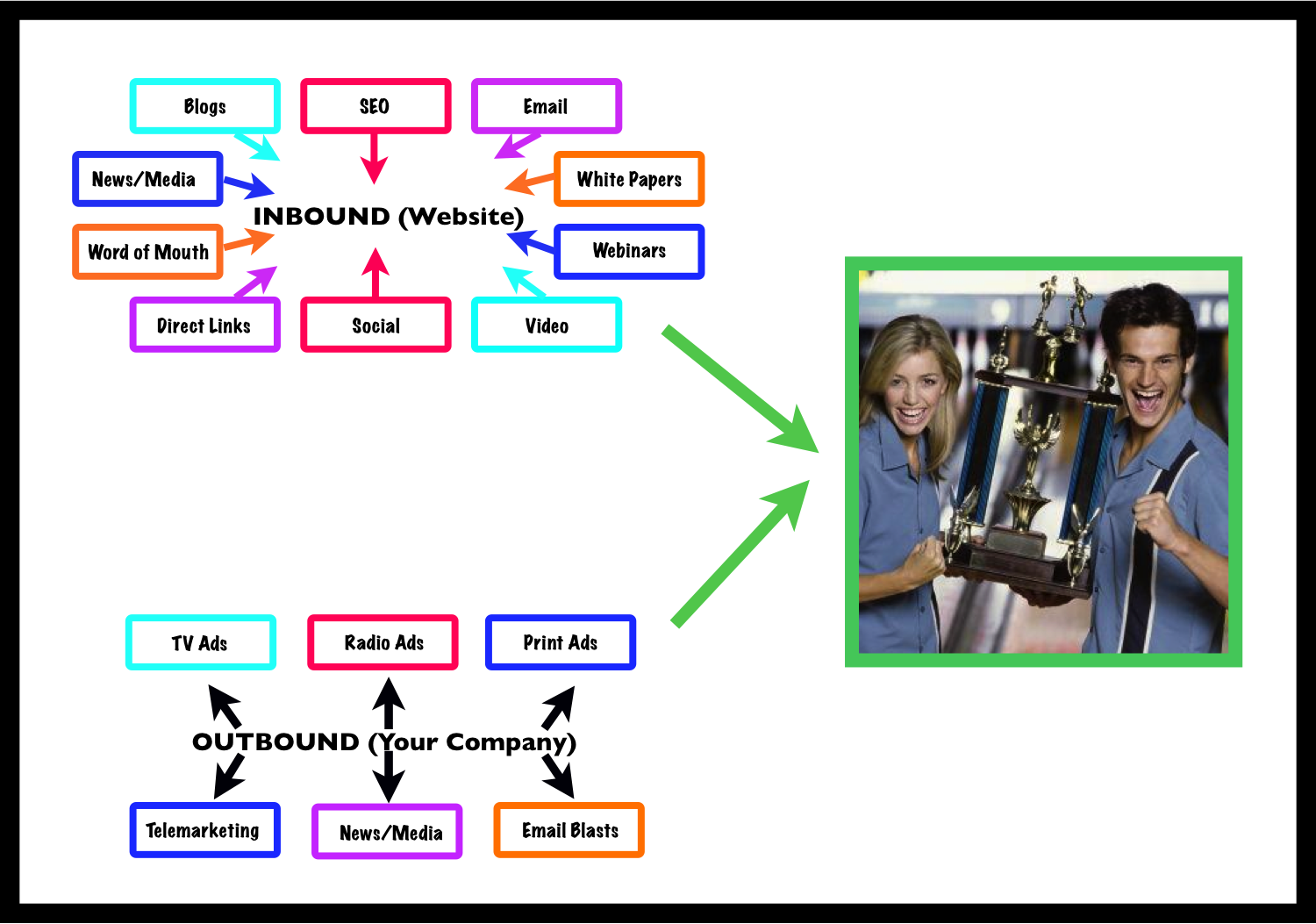
Inbound VS. Outbound : Not so Black and White


At this point, most of us are sold on the concept of inbound marketing, coined by Brian Halligan, CEO and co-founder of Hubspot. We believe that generously pushing content (blogs, whitepapers, YouTube videos) out on to the www will help build brand awareness, show that we produce value for our leads and customers, and ultimately this this will drive traffic back to our own websites, convert visitors to leads, leads to sales, and so on. 

Inbound, at this point, is undeniable, but outbound is not dead.  Traditional channels are still important, especially in selling to larger enterprise companies who may not have the same research behavior as B2C or smaller B2B companies.

When the first photograph was made in 1826, there was buzz that painting was dead. Technology changes the tools that we use for specific jobs, but in the case of photography vs. painting, no longer did a family that wanted to have their portrait captured have to sit for hours and days on end. With photography, they could sit for 10 minutes. (Back then, to get enough light exposure you needed to sit for a very long time.) But, you get my point: 10 minutes is a lot less than 10 days. Photography may have changed the portrait, but it hasn’t changed the value of painting. Painting has taken on a different function in our culture now, not utilitarian, but high art.

Not dead just different. 

Outbound marketing is not dead. We still advertise; we have just changed the emphasis on the mediums where we advertise.  We still send emails; we have just changed how and who we send them to, especially if you have a lead scoring system in place.  Instead of writing off outbound, we should highlight the things that still work and figure out what tools that will nudge our marketing efforts along.

Temporal event data is the key to starting and building business relationships.  No one wants endless solicitations. However, if they receive a personal email congratulating them on their sales win or new promotion, they are much more likely to respond.
 
Marketing automation has helped manage and quickly respond to business behavior helping with personalized interactions. Adding triggers into this system just makes it that much more personal and that much more timely.  Not just an email sent by a sales rep when someone downloads a whitepaper, but a proactive communication to start a relationship.  This isn’t spamming; this is letting someone know you care about what they do and that you are paying attention.  This takes out the skepticism of emailing. While this approach isn’t simply inbound or simply outbound, it is using technology to discover who and when to communicate to and with what relevant message based on their events and behavior. Big data is doing this all the time in the consumer world.

We should be wary in dismissing outbound approaches and realize that there is always value in different methodologies, even if they aren’t the hot topic; we need to decipher what value can be extracted from what programs and adjust to fit our end goals.

Thursday, June 14, 2012

Coffee: Good For You; Great For Your Automation System


Remember Glengarry Glen Ross, where Alec Baldwin abrasively declared: “Coffee's for closers”?  Well, keep this in mind as you read on:

Can you relate to my typical day? I wake up and instantaneously check my iPhone: emails, Twitter, and click on the few headlines that grab my attention. The day starts off strong and hyper-focused. 

But, as the day wears on, after I have eaten lunch and I am in the post-prandial torpor slump. (Latin: after eating you get tired - thanks mom, for insisting that I take Latin.)  It is hard to get motivated again.  I have a late afternoon meeting, where if someone mentions, “low hanging fruit” or “synergy” one more time, it is quite possible I will scream.  Can you relate?

Afternoon caffeine boost is mandatory. Pronto. 

Go with me on this analogy: compare your own post-prandial state to that of your marketing automation software and your CRMs. We realize that if you are an enterprise company, you already have fantastic CRMs and marketing automation systems in place with lots of data. But, could they, too, need a midday caffeine boost of event-based triggers?

At iLantern, we talk, think, eat, and breathe triggers. Why? Well, because that is what we sell, and more importantly what we whole-heartedly believe in to help revolutionize smart marketing and smart selling. In the world of Inbound and Cloud-based marketing, it only makes sense to use temporal business intelligence to drive more business for your company—to boost your marketing automation and CRM systems. 

Caffeinate your software. (I better ™that soon, before someone else grabs it.)

I want to clarify what boost means. It means honing in on the right data. In the age of automation, we sometimes forget the importance of quality over quantity.  Sending out mass emails does not work any more.  We did a test to see for ourselves, as well as endless stats from Marketing Sherpa and other great sources to show the need for thoughtful segmentation and timing.  TRIGGERS HELP in these categories.  Know when and who to send the email to – and, not only will your open rates improve, but your call-to-action might actually get clicked. What a concept.


When I say a caffeine boost, I mean QUALITY not quantity. I mean actually knowing what company has a need for your product based on temporal business data and digital body language™.  I mean sharp and concise event data wrapped into your already existing solution to help you do your job that much better. 

And yes, “Coffee's for closers” – So, go ahead and drink up.


Visit us at: www.ilantern.com
Follow us on Twitter 
Follow us on Facebook
Follow us on Linkedin

Wednesday, May 30, 2012

So Much Content, So Little Time


In the world of content marketing, we are used to hearing the phrase, “Content is King”.  Although I wouldn’t argue with that statement in theory, one of the problems now is that there is so much content out there, how do you find what you are looking for and what is most meaningful to you in a reasonable amount of time?

Tell me if you can relate: you have a twitter feed that you check multiple times a day, you use Google alerts, you check Facebook, LinkedIn, RSS feeds and the plethora of news sources all for content you think might help you do your job more efficiently. “Efficiently” being the key word.  Is your process truly efficient, meaning a good use of your time and the company’s money?   For marketers this means discovering relevant topics that you can share with leads and clients and developing the right campaigns to drive more business.  For sales this means narrowing in on the right prospects to begin the sales cycle.  It can seem overwhelming, even if you are like me, and have processes in place to consume all this content. 

It is both, incredibly exciting to live in a time of mass content consumption, and also can be littered with a lot of BS (if you don’t mind be saying). But, either way, it is now part of our jobs in marketing and sales; we must stay tuned in to all the platforms that allow for this diaspora of information or we risk latency or worse, irrelevancy. 

Ever hear the phrase, “Necessity is the mother of invention”? For me, I have learned to function with this influx of content and my limited time, by using event triggers to see what is happening in the companies that I care about.  I use that information to provide the right messaging to the groups I am interested in targeting.  This means fine-tuning all the content into the filters and triggers that I care about—eliminating the BS.

Trigger data about specific companies allows you to focus in on their events in order to narrow in on relevant event data, and in turn, decide what messaging you want to push out in your lead’s direction.

There is a difference between informative content that can help you get a pulse into the sense of the business sector you are interested in, and there is actionable content that lets you narrow in on companies that have pain points in tandem with your products and services.  Event data actually helps with both: allowing you to see the temporal events and content that have occurred in the companies that you track, as well as giving you the context you require to decide what to action on next. 

What’s the take away here?

Time is truly of the essence. First, we could all use a whole lot more of it, but hey, it probably isn’t going to happen.  So… using event triggers gives you your 30 minutes back, so you can get back to marketing and selling.

Visit us at: www.ilantern.com
Follow us on Twitter 
Follow us on Facebook
Follow us on Linkedin

Thursday, May 10, 2012

You Walk into a Bar. What do you do Next? (This is Sales and Marketing Related)


I promise this isn’t a bar joke.

 You walk into a bar, there are a group of people in a circle talking to each other; they all seem to know one another. You are by yourself and are looking to make some new friends. What do you do?  Do you run up to the crowd of 20 and say, "HI! I’m X. I live in X and I drive X and I love to play X and I just did X."  This would not only be extremely off-putting to the group you are announcing it to, but also not adhere to social norms of communication. Instead of assaulting the group of people, hoping that one might bite at your proclamations, why not wait for a point-of-entry? Or even better, listen to what the group is discussing and think of an engaging question that will trigger some of the folks to answer and engage with you?

There are two adages that most marketing and sales folks know: “Market to One” and “People Buy From People”.  Why don’t we try to create meaningful digital conversations that make emotional appeals and build relationships where both parties benefit and actually want to listen to one another?

Ever get an email where you are invited to a webinar from a sales rep and have no idea why you were put on a list cluttering your mailbox?  We all know that we are inundated with emails, so it is infuriating to get one more that just doesn’t relate to you and frankly, is wasting your time.

In the age of technology, we not only need, but also depend on automation software to organize, measure, create and stream our process for lead generation, segmentation and lead nurturing. But, with so much volume, there is potential for proclamations to the wrong person at the wrong time.  Using automation infused with event triggers and data allows you to mimic real human interaction, by allowing you to LISTEN for triggers that you can relate to and also letting you bring something relevant to add to the conversation when the time is right. In other words, don’t be Bob.

Visit us at: www.ilantern.com
Follow us on Twitter 
Follow us on Facebook
Follow us on Linkedin